Unraveling the Mystery
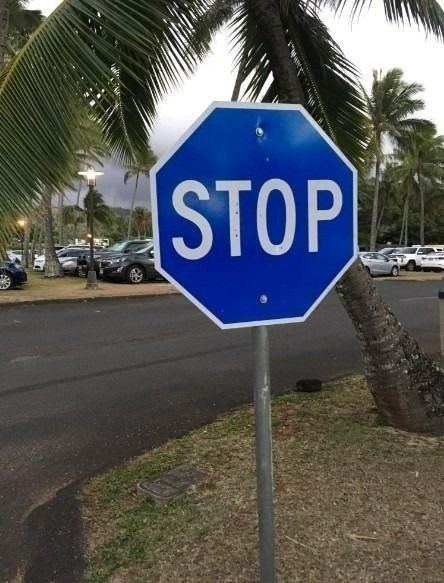
Stop signs are among the most universally recognized symbols in the modern world. Even young children, long before they learn to read, can identify the bold red octagon and understand its command: stop. The design is so ingrained in our collective consciousness that any deviation from it immediately grabs attention. That’s why encountering a blue stop sign can feel confusing, intriguing, or even unsettling. Is it real? Is it legal? Is it a mistake—or a message?
Why Are Stop Signs Red in the First Place?
To understand the significance of a blue stop sign, we first need to understand why stop signs are red at all.
The Origins of the Stop Sign
The first stop signs appeared in the early 20th century, long before modern traffic standards existed. In 1915, the city of Detroit introduced one of the earliest stop signs. It wasn’t red—it was white with black lettering and square in shape. At the time, consistency across cities or countries didn’t exist. Traffic signs varied wildly in color, shape, and message.
As automobile use increased, so did accidents. Governments realized the need for standardized traffic control devices that drivers could recognize instantly, even from a distance or at high speeds.
Why Red Won
Red had long been associated with danger and urgency. Railroads used red signals to indicate “stop” decades before cars became common. The color stands out against natural landscapes, especially during daylight hours, and triggers a psychological response linked to caution and alertness.
By the mid-20th century, red stop signs became the international standard, reinforced by the Vienna Convention on Road Signs and Signals (1968), which standardized traffic signage across many countries.
It’s not just the color that matters. The stop sign’s eight-sided (octagonal) shape allows drivers to recognize it even when it’s obscured by snow, dirt, or darkness. A driver approaching from behind can identify the sign by its shape alone.
Red + octagon = stop. That pairing is intentional, tested, and globally reinforced.
So when you see a stop sign that’s blue, it immediately violates decades of visual conditioning.
The Shock of a Blue Stop Sign
Imagine driving down a quiet road and seeing a stop sign that looks… wrong. The familiar octagon is there, but instead of red, it’s blue. Your brain hesitates. Is this real? Do I stop? Is this a prank?
That moment of hesitation is exactly why blue stop signs are so fascinating—and why they’re rarely used in official traffic control.
Why Blue Feels “Wrong”
So when blue and “STOP” appear together, it creates cognitive dissonance. The message says one thing; the color says another.
Are Blue Stop Signs Legal?
This is one of the most common questions people ask after encountering one.
The Short Answer
In most countries, blue stop signs are not legally recognized traffic control devices on public roads.
The Longer Answer
Traffic signs on public roads must comply with national or regional standards. In the United States, this is governed by the Manual on Uniform Traffic Control Devices (MUTCD). In Europe and many other regions, similar regulatory frameworks exist.
Under these standards:
Stop signs must be red
They must be octagonal
They must display white lettering
A blue stop sign fails these requirements and therefore cannot legally enforce a stop on public roads.
However, legality changes when we move off public roads.
Private Property: Where Blue Stop Signs Often Appear
One of the most common legitimate places you’ll see a blue stop sign is on private property.
Parking Lots and Campuses
Shopping centers, corporate campuses, factories, gated communities, and university grounds often install their own traffic signage. Because these areas are privately owned, they are not legally required to follow public road standards—though many do for clarity and safety.
In these settings, a blue stop sign may be used to:
Distinguish private traffic rules from public ones
Match branding or aesthetic themes
Signal lower-speed, lower-risk environments
Do You Have to Obey Them?
Legally, enforcement is tricky. Police typically cannot issue traffic citations based solely on private signage unless local laws or agreements allow it. However:
Property owners can enforce rules internally
Insurance liability may still apply
Ignoring signs could lead to removal from the property
In practice, it’s usually wise to obey them.
Blue Stop Signs as Art and Protest
Not all blue stop signs are meant to control traffic. Some are meant to make a statement.
Artistic Installations
Artists have long used familiar symbols to provoke thought, and traffic signs are perfect for this. A blue stop sign can be an artistic tool that asks:
Who decides the rules?
What happens when authority looks different?
How much do we rely on conditioning instead of critical thinking?
In galleries, public art installations, or temporary exhibits, blue stop signs are often symbolic rather than functional.
Political and Social Commentary
In some cases, altered stop signs—including blue ones—have been used as protest art. The change in color draws attention and forces viewers to reconsider concepts like control, obedience, and conformity.
Because stop signs are so authoritative, altering them can feel subversive—even when no laws are broken.
Psychological Impact: Why Color Matters So Much
Color psychology plays a huge role in how we interpret signs.
Red vs. Blue
Red increases heart rate, signals danger, and demands immediate action.
Blue lowers stress, signals safety, and promotes trust.
When paired with the word “STOP,” blue creates mixed signals. The brain must work harder to reconcile the instruction with the emotional tone of the color.
Conditioning and Muscle Memory
Most drivers don’t consciously read stop signs. They react automatically. This is the result of years of conditioning.
A blue stop sign disrupts that muscle memory. The hesitation it causes is proof of how deeply standardized design affects behavior.
Ironically, that hesitation is one of the strongest arguments against using nonstandard stop signs on public roads.
International Variations and Rare Exceptions
While red stop signs dominate globally, there have been rare historical or regional deviations.
Japan’s Early Stop Signs
Japan originally used triangular yellow stop signs before transitioning to red octagonal ones to align with international standards. Even then, the text was initially written in Japanese rather than English.
Experimental Zones
Occasionally, researchers or urban planners experiment with nonstandard signage in controlled environments to study driver behavior. These experiments are closely monitored and not meant for general adoption.
Blue stop signs have appeared in such contexts, but almost always temporarily.
Internet Myths and Urban Legends
The rarity of blue stop signs has made them fertile ground for misinformation.
Common myths include:
“Blue stop signs are for police only”
“They indicate optional stopping”
“They mean stop only at night”
“They’re used during emergencies”
None of these are true in any standardized traffic system.
Social media has amplified these myths, often using photos taken on private property or in art installations without context.
Branding and Aesthetic Choices
Some private developments choose blue stop signs for purely visual reasons.
The Rise of “Designed Environments”
Modern architecture often emphasizes cohesion. Developers may choose custom signage to match:
Corporate colors
Luxury branding
Minimalist aesthetics
In these environments, the stop sign is less about authority and more about gentle guidance.
This approach works only because speeds are low and drivers are already cautious.
Safety Concerns and Criticism
Not everyone is a fan of nonstandard stop signs.
Why Traffic Engineers Object
Traffic safety relies heavily on instant recognition. Any deviation increases reaction time—even slightly—and that can matter in high-risk environments.
Critics argue that blue stop signs:
Undermine decades of safety research
Confuse drivers unfamiliar with the area
Set a dangerous precedent if widely adopted
For this reason, transportation authorities strongly discourage their use outside private or experimental settings.
What Should You Do If You See One?
If you encounter a blue stop sign, the safest approach is simple:
Stop.
Even if the sign isn’t legally enforceable, stopping avoids accidents, misunderstandings, or conflicts with property owners.
When in doubt, caution is always the smarter choice.
Symbolism: What a Blue Stop Sign Represents
Beyond legality and safety, the blue stop sign has taken on a symbolic life of its own.
It represents:
A challenge to authority
The power of design to influence behavior
The thin line between rule and suggestion
How deeply we rely on visual language
In a world full of signs telling us what to do, a blue stop sign asks a quiet but powerful question:
Why do you stop when you stop?
The Bigger Picture: Why Standards Matter
Continue reading…
