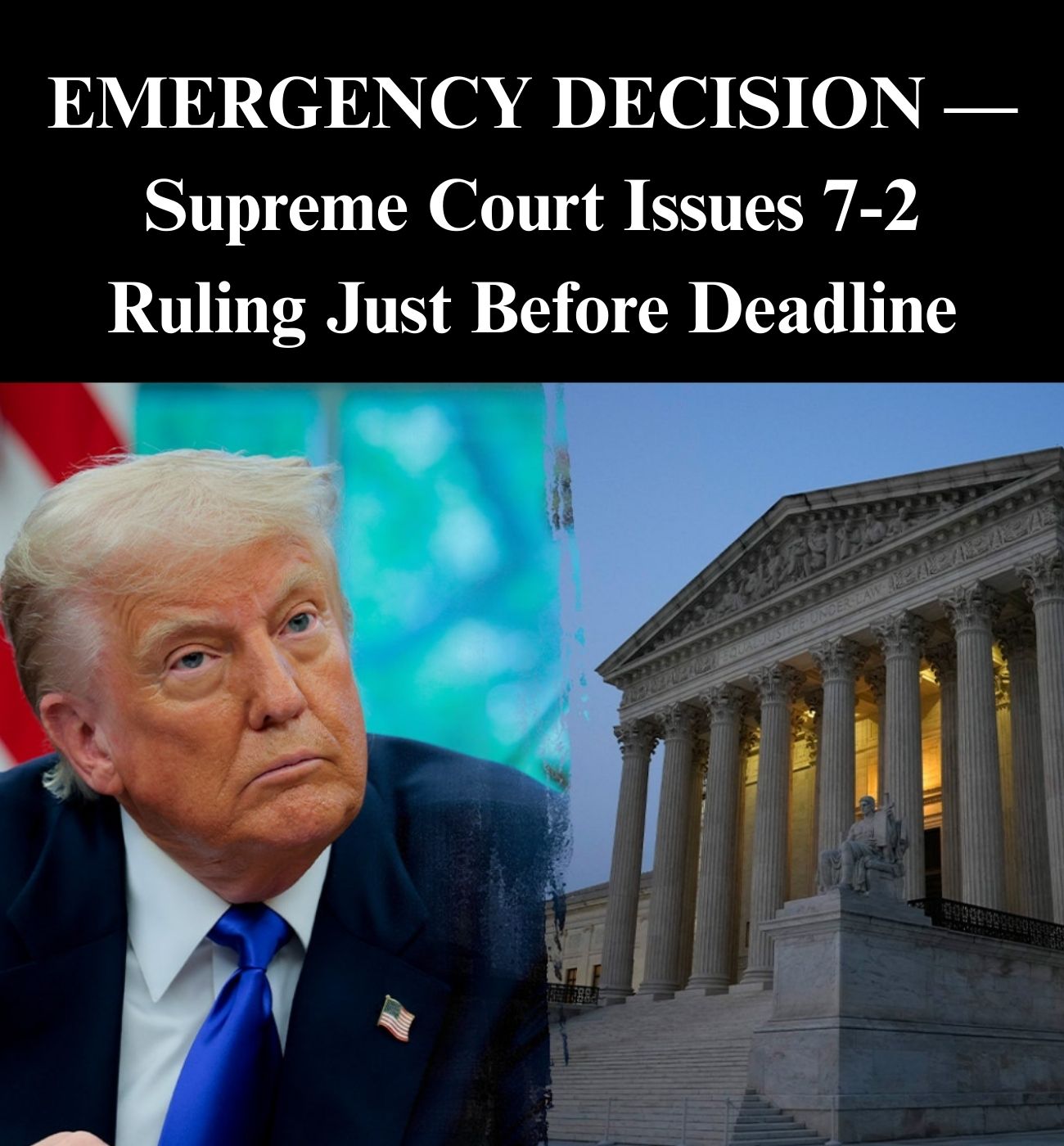
U.S. Supreme Court Refuses to Reinstate Florida’s Immigration Law — Comprehensive Overview
On July 9, 2025, the United States Supreme Court declined to reinstate a highly controversial Florida state law designed to impose criminal penalties on certain people living in the U.S. without lawful status who enter the state of Florida. The refusal came in an emergency request filed by Florida’s Attorney General and leaves in place a block ordered by lower federal courts while constitutional challenges proceed.
Florida’s Legislature passed Senate Bill 4‑C (“SB 4‑C”), signed into law by Governor Ron DeSantis earlier in 2025.
The law aimed to make it a state crime for people living in the U.S. illegally to enter or re‑enter Florida after deportation or denial of entry. Prosecutors could pursue felony charges and impose prison terms.
Under the law’s language:
First offenses would carry mandatory prison terms of around 9 months.
Repeat offenses or those with prior deportations or court orders could face longer sentences.
State Justification for the Law
Florida officials argued the statute was intended to supplement federal immigration enforcement and protect the state from harms associated with large numbers of undocumented migrants.
The Attorney General contended that:
The law did not conflict with federal immigration statutes,
And lower courts should not block enforcement while legal challenges continue.
2. Constitutional and Legal Context
Federal Supremacy in Immigration Law
The U.S. Constitution gives the federal government exclusive authority over immigration and naturalization. This stem from:
The Supremacy Clause, ensuring federal law prevails when conflicts arise,
Longstanding Supreme Court precedent reaffirming that states cannot independently regulate immigration in areas that intrude on federal functions. (See Arizona v. United States (2012), which struck down similar state provisions under federal preemption doctrine.)
Why States Have Tried Their Own Laws
Federal vs State Criminal Jurisdiction
Immigration law federally is primarily civil in nature. Federal statutes handle admission, removal, and certain crimes that relate to illegal entry and re‑entry but do not generally authorize state governments to impose independent criminal penalties.
When states attempt to create overlapping criminal statutes, courts often ask whether the law is “preempted” — that is, whether it conflicts with federal law or upsets the federal balance of power.
3. Legal Challenges in Lower Courts
From its inception, SB 4‑C was attacked in court almost immediately after passage:
ACLU Lawsuit
The American Civil Liberties Union (ACLU) of Florida, the Florida Immigrant Coalition, Farmworker Association of Florida, and individual plaintiffs filed a lawsuit in April 2025.
They argued:
Florida’s law was unconstitutional because it intruded on federal immigration authority.
It violated the Supremacy Clause,
It could lead to discriminatory enforcement practices,
And it violated due process of law.
District Court Injunction
A federal judge (Judge Kathleen Williams) granted a temporary restraining order and then a preliminary injunction blocking enforcement across the state, finding it likely unconstitutional and preempted by federal law.
Contempt Finding Against Florida’s AG
After the injunction, Florida Attorney General James Uthmeier was found in civil contempt of court for instructing officers to continue enforcement despite the judge’s order. The court held that:
He failed to properly notify all law enforcement of the injunction,
And then issued guidance contrary to the injunction’s terms.
Eleventh Circuit Court of Appeals
Florida appealed. In June 2025, the 11th Circuit refused to stay the district court’s injunction, meaning the block on enforcement remained in place while litigation proceeds through appeals.
Emergency Application to the Supreme Court
After the 11th Circuit refused to lift the injunction, Florida’s Attorney General petitioned the U.S. Supreme Court for an emergency stay — essentially asking the high court to temporarily allow enforcement while the cases play out.
4. What the Supreme Court Did
Refusal to Reinstate the Law
On July 9, 2025, the U.S. Supreme Court denied Florida’s request to reinstate enforcement of SB 4‑C.
The Court did not issue a full written opinion nor indicate detailed reasoning — a common practice in emergency orders.
There were no noted dissents on the emergency order itself.
What This Means
The Court’s refusal did not decide the ultimate constitutionality of the law on the merits.
Instead, it simply left in place the district court’s injunction while the legal challenge continues in lower courts.
Practically, State law cannot be enforced — arrests and prosecutions under SB 4‑C remain barred while the injunction stands.
5. Legal Reasoning Behind the Supreme Court’s Refusal
Although the Court did not publish an expansive opinion, several key theories undergird why justices likely refused the stay:
Precedent on Federal Supremacy
The Supreme Court in Arizona v. United States (2012) held that state laws cannot usurp federal authority to regulate immigration.
Based on that precedent and intervening lower court rulings, there is substantial legal basis to question whether SB 4‑C intruded into federal territory — a reason justices might have been reluctant to enable enforcement while challenges proceed.
Balance of Harms
In emergency applications, the Court considers:
Likelihood of success on appeal,
Irreparable harm to the parties,
Potential harm to others,
And public interest.
A stay might allow enforcement of a law that could later be struck down as unconstitutional — meaning irreversible harm to individuals subject to prosecution — while preserving the injunction minimizes harm until the issues are fully litigated.
Respect for Lower Court Proceedings
The Court often refuses to intervene prematurely when factual records and legal development are still underway in lower courts.
6. Political, Public, and Practical Context
Florida Politics
Supporters of the law see it as a strong stand against illegal immigration — aligned with conservative priorities on border security and public safety.
Governor Ron DeSantis and Florida lawmakers championed the law as a way for the state to assert control over immigration impacts on local communities.
Opposition and Civil Rights Advocacy
Civil liberties and immigrant‑rights groups warn that criminalizing undocumented entry can:
Lead to abuses,
Encourage racial profiling,
Undermine federal uniformity in immigration enforcement,
And create a patchwork of conflicting state policies.
Federal Government Involvement
The U.S. Department of Justice filed an amicus brief siding with Florida in the appeals process, arguing that the state law complements federal immigration objectives and does not “preempt” federal authority.
Interestingly, that position contrasts with many federal lawsuits challenging similar state laws nationwide.
7. Broader Implications for Immigration Policy
State vs. Federal Authority
The refusal underscores that immigration policy remains fundamentally a federal function under U.S. constitutional law.
If states could independently criminalize entry or establish enforcement regimes, it could fracture the uniformity of the national immigration system.
Impact on Other State Laws
Similar state laws in Texas, Oklahoma, and other states have also been blocked in federal courts. These results suggest a trend: when states attempt to impose criminal penalties traditionally reserved for federal enforcement, courts will scrutinize them under preemption and constitutional principles.
Rising Litigation
The legal fight over SB 4‑C will continue in the 11th Circuit and potentially return to the Supreme Court on the merits later. Depending on how the courts rule, this case could further clarify limits on state immigration legislation.
8. What Happens Next
Appeals Continue
Florida will continue to pursue its appeal in the 11th Circuit Court of Appeals.
After that, the case could return to the Supreme Court for a final decision on the merits.
Possible Outcomes
If upheld: A future Supreme Court decision in favor of Florida could reshape boundaries between federal and state power in immigration.
If struck down: The decision would reaffirm federal primacy and limit state innovation in immigration enforcement.
Continue reading…
