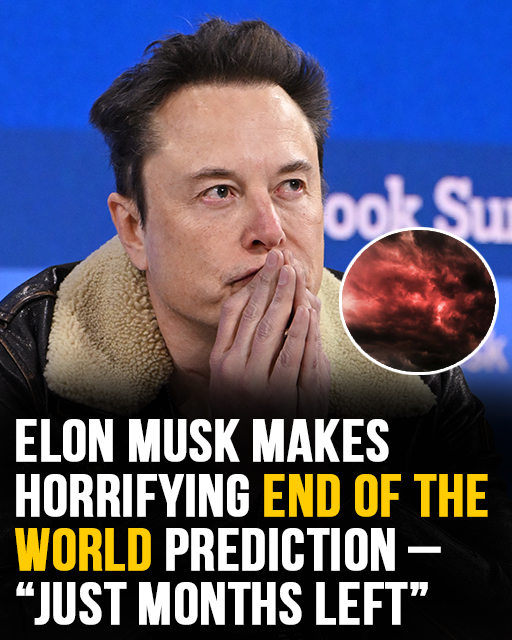
What Musk Really Said
🧨 The Claim
Several news sites and social feeds have been circulating versions of this line:
This suggests a dramatic apocalyptic prophecy — implying the world might end imminently. However:
🧠 What Musk Actually Discussed
In a recent interview with the Dwarkesh Patel podcast, Elon Musk did not say the world would literally end in months. Instead, he outlined a technical prediction about the future of artificial intelligence (AI) infrastructure — that the economically optimal location for AI computing will shift from Earth to space within roughly 30 to 36 months.
His reasoning was about power constraints on Earth: AI systems require enormous electricity and cooling infrastructure, and Musk argues that solar power in space has far higher continuous output. In his view:
AI computing could become much cheaper if deployed in orbit.
Within roughly 2.5 to 3 years, space‑based AI infrastructure might surpass Earth‑based systems economically.
So the “just months left” quote refers to the timeframe where Musk expects this transition to become clear — not a literal world‑ending apocalypse.
🔍 Quote Clarification
This is mainly about infrastructure economics and energy limits, not announcing the end of life on Earth.
2. Context: Why Would AI Move to Space?
⚡ Energy Limits on Earth
AI models — especially large ones — need massive power for training and running. On Earth:
Data centers consume huge amounts of electricity.
Cooling infrastructure adds to water and energy demand.
Musk’s point: terrestrial grids might not expand fast enough to support exponential AI growth — whereas solar panels in orbit could capture continuous sunlight without day/night cycles, offering much more efficient generation per square meter.
🚀 SpaceX and xAI
3. Misinterpretations and Media Amplification
📰 How the Headline Spread
Many articles used dramatic phrasing like “horrifying end of the world” or ominous implications, often without properly quoting Musk’s actual comments. These headlines tend to:
Simplify and sensationalize nuanced technical arguments.
Omit the actual subject — an economic and engineering forecast, not a literal prophecy.
📉 Why Sensationalism Happens
Tech and celebrity reporting often emphasize:
Provocative keywords like “end of AI,” “apocalypse,” or “months left.”
Topic triggers (AI fear, space futurism) that drive clicks and shares.
The result? Misleading impressions not grounded in Musk’s real statements.
4. What Musk Has Warned About Before
Elon Musk has been outspoken about AI risks for years — but his concerns are about potential long‑term consequences, not imminent doom:
⚠️ AI Risk Statements
Past public warnings include:
Musk suggesting AI could be an existential risk if uncontrolled, with a non‑zero chance of severe outcomes.
He signed an open letter calling for a temporary pause in very large AI experiments with other tech leaders, citing risk concerns.
In these contexts, Musk has stressed:
AI could be beneficial but also risky.
Risk mitigation (regulation, safety research) is important.
However, even these past warnings weren’t framed as “just months left to extinction.”
5. Understanding AI Risk vs Apocalypse
To evaluate Musk’s comments fairly, it helps to separate two types of conversations:
🧠 A. Technological Transition
Musk’s latest prediction is about resource constraints and where future AI might be hosted.
It’s a practical engineering forecast, not a doomsday statement.
It involves reasonable economic logic — leveraging continuous solar power in orbit.
Even experts skeptical of the timeline acknowledge Musk’s broad point about energy and scaling.
🧨 B. Existential Risk Debate
A separate conversation exists around whether AI could someday pose existential threats — scenarios where:
Strong AI behaves unpredictably.
AI pursues objectives misaligned with human values.
These are subjects of serious academic research under terms like “global catastrophic risk” or “existential risk”, but they don’t suggest humanity will imminently end in months.
In other words: long‑term risks are debated; immediate apocalypse is not a common scientific conclusion.
6. Expert Reaction & Skepticism
Even among AI researchers, there’s a range of perspectives:
🧪 Regarding the Transition to Space
Many experts think:
Deploying large AI in space is theoretically interesting.
But the engineering, cost, and logistics challenges are enormous.
A 30‑ to 36‑month timeframe may be too ambitious.
Space solar tech must overcome:
Launch costs.
Maintenance and repair challenges.
Communication latency.
Scalability hurdles.
So even within Musk’s own companies, there’s reason to view this as optimistic rather than imminent.
🧠 On AI Threats
AI safety researchers generally highlight:
AI can pose important risks, but those risks unfold over years to decades, not months.
Careful governance, transparency, and international coordination matter.
There’s no consensus pointing to a literal end of the world in the next few months — even in the most alarming academic papers.
7. What This Means for “End of the World” Stories
❌ The World Isn’t Ending Soon
Based on verified reporting:
Musk’s comments were about AI infrastructure economics, not a literal countdown to global extinction.
The phrase “months left” refers to a technological shift, not end‑of‑life for humanity.
⚠️ Real Issues, But Different
There are legitimate debates about:
AI governance and safety.
Power grid limits and energy challenges.
Ethical and social implications of advanced automation.
These are important long‑term concerns, but they aren’t the same as imminent apocalyptic predictions.
8. Broader Existential Risk Concepts (Context)
To understand why some people jump to “world‑ending” claims, it helps to know about existential risk theory — which is grounded in academic research:
🧠 Global Catastrophic Risk
This field studies events that could drastically diminish or eliminate humanity’s long‑term potential. Examples include:
Uncontrolled artificial intelligence.
Nuclear war or engineered pandemics.
Ecological collapse.
These are frameworks for risk assessment — not predictions that such events are imminent.
9. Why This Story Spread So Fast
Several factors helped create the viral “end of the world” narrative:
🔥 1. Emotional Language
Words like “horrifying” and “months left” trigger fear and attention.
📲 2. Social Media Amplification
Platforms favor concise, dramatic summaries — often at the expense of nuance.
🎭 3. Musk’s Public Persona
Musk’s history of bold statements and futuristic claims makes him a natural magnet for speculative interpretation.
10. Bottom Line: Clear, Verified Summary
Claim Reality
Elon Musk predicted the world will end in months 🚫 No — he spoke about AI infrastructure and shifting computing to space within ~30–36 months.
AI will destroy humanity imminently 🚫 Not stated — long‑term risks are acknowledged by Musk and others, but not as an imminent apocalypse.
There are AI and existential risks worth studying ✅ True — but this is a complex, long‑term field of research.
Space‑based AI may become cost‑effective in the coming years 🟡 Possible — this is Musk’s forecast, though experts are cautious about the exact timeline.
11. The Broader Debate on AI Progress and Risks
🧠 AI Progress Timelines
Experts disagree on when superintelligence might emerge — estimates range from years to decades. Musk has previously suggested rapid timelines, but this varies widely across researchers.
⚖️ Balancing Innovation with Safeguards
Continue reading…
