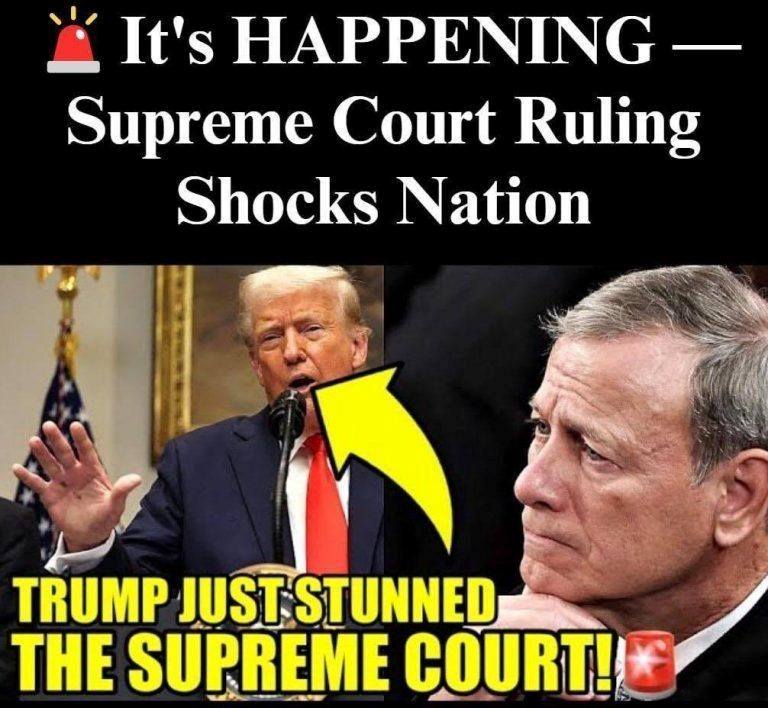
🔥 Supreme Court Ruling Sends Shockwaves Through Nation After Trump’s Bold Move
Introduction — A Turning Point in American Judicial and Political History
On June 27, 2025, the United States Supreme Court issued one of the most consequential rulings in modern American history, fundamentally reshaping the dynamics of executive power, judicial oversight, and constitutional governance. In a 6–3 decision arising from emergency applications related to President Donald Trump’s highly controversial executive order on birthright citizenship, the Court held that federal district judges do not have the authority to issue “nationwide injunctions” blocking federal policies across the entire country — a legal tool widely used in recent decades to prevent government actions from taking effect nationwide while lawsuits proceed.
📘 Background: Trump’s Executive Order on Birthright Citizenship
In January 2025, President Trump signed Executive Order 14160, aimed at restricting or fundamentally altering the practice of birthright citizenship — the constitutional guarantee that virtually anyone born on U.S. soil is automatically a U.S. citizen under the 14th Amendment. This order sought to reinterpret the long-standing legal understanding of the Citizenship Clause by exempting children born to parents with temporary lawful status (like certain visa holders) or no legal status at all.
Almost immediately, multiple lawsuits were filed by states, advocacy groups, and civil rights organizations asserting that the executive order violated the Constitution. Federal judges around the country responded by issuing preliminary injunctions blocking enforcement of the policy — not just for the specific plaintiffs before them, but nationwide, citing irreparable harm if the order were allowed to go into effect while litigation continued.
This form of legal relief — known as a nationwide injunction — has become increasingly common over the past decade, particularly in cases involving immigration and executive power. Unlike typical court orders that apply only to the parties that brought the case, nationwide injunctions can halt government action for everyone in the country, often resulting in situations where one judge’s ruling determines national policy.
🧑⚖️ The Supreme Court’s Decision: Limiting Nationwide Injunctions
The Supreme Court’s ruling did not address the constitutionality of the birthright citizenship executive order itself. Instead, it resolved a narrower but equally explosive legal question: Do federal district judges have the authority to issue “universal” or nationwide injunctions that block federal executive policies across the country?
In Trump v. CASA, Inc., consolidated with related cases, the Court ruled that nationwide injunctions likely exceed the equitable authority granted to federal courts under the Judiciary Act, and that courts should ordinarily only grant injunctions providing “complete relief” to the specific plaintiffs — not sweeping nationwide prohibitions.
Key Elements of the Ruling
🧠 The Court’s order focused on remedy and procedure, not the underlying legality of Trump’s executive actions.
⚖️ Chief among the majority’s concerns was that nationwide injunctions disrupt the Constitution’s case-or-controversy requirement and allow one judge to unilaterally set national policy.
⚖️ The enforcement and scope of lower-court injunctions were remanded for reconsideration in light of the new rule.
Legally, this shifted the battlefield: Instead of universal blocks, opponents of Trump-era policies would now need class-action injunctions or case-by-case suits to try to protect broad swaths of affected individuals — a far more burdensome process that limits the judiciary’s ability to halt executive actions before they take effect.
🗣️ Trump’s Response: Triumph and Strategy
At the White House, President Trump characterized the ruling as a “monumental victory for the Constitution, the separation of powers, and the rule of law.” He and senior administration officials argued that nationwide injunctions had constituted an unconstitutional overreach by unelected federal judges, shackling presidential authority and thwarting the will of voters who elected him to implement specific policies.
Republican leaders in Congress echoed Trump’s praise, calling the decision a long-overdue correction that restored balance between the branches of government. They stressed that executive actions on immigration, national security, environmental policy, and deregulation would now be more likely to take effect as intended, even as legal challenges proceed in more narrow, case-specific contexts.
📉 Critics’ Alarm: Judicial Power Eroded?
Legal scholars, civil rights advocates, and Democratic lawmakers responded with alarm. They asserted the Supreme Court’s limitation of nationwide injunctions effectively undermines the judiciary’s core function as a check on executive overreach, particularly in cases involving constitutional rights.
Concerns Raised by Critics
☠️ Nationwide injunctions were a key tool to prevent irreparable harm before full legal resolution; limiting them means harmful policies could reach millions before courts can act.
📉 Lower courts might struggle to provide timely relief to broad groups of people affected by government actions, leading to patchwork enforcement of federal law depending on jurisdiction.
📚 Civil liberties groups argued that widespread challenges — from immigration orders to environmental protections — would become significantly harder to contest effectively.
📢 Critics warned the ruling could embolden the executive branch to push controversial policies knowing that nationwide judicial blocks are far less likely.
ACLU and other advocacy organizations publicly committed to pursuing class-action lawsuits to protect groups affected by Trump’s policies — a strategy that could now become the primary way to seek broad judicial relief.
🗳️ Political Ripples: Midterm Elections and Beyond
The Supreme Court’s ruling did not occur in a vacuum. It arrived at a moment of intense political contention, especially as the 2026 midterm elections approached — elections that could determine control of Congress and influence the direction of American policy for years.
Key Political Consequences
📌 Redistricting Battles
Just days after the nationwide-injunction decision’s legacy took shape, the Supreme Court issued another high‑profile emergency order in early February 2026: allowing California to implement a new congressional map that could flip up to five seats in favor of Democrats in the 2026 elections — rejecting a plea by California Republicans and the Trump administration to block the map.
The decision underscores the complex, often unpredictable interplay between the Court and partisan politics. While the six‑justice conservative majority sided with the Trump administration on injunctions, it simultaneously cleared the constitutional path for a Democratic‑leaning redistricting plan.
Analysts suggest this reflects a broader judicial philosophy aimed at limiting federal judicial intervention rather than favoring one party’s electoral fortunes outright. The Court’s approach leaves states more leeway to determine electoral maps despite ongoing partisan conflict.
📜 Legal and Institutional Impacts
📉 Judicial Function
For the federal judiciary, the ruling marks a structural shift in how courts will interact with executive policymaking:
⚖️ Judges are now more constrained in crafting broad injunctions that halt nationwide policies.
⚖️ Plaintiffs challenging federal actions likely will need to pursue classwide relief or litigate in multiple jurisdictions simultaneously.
⚖️ The ruling could accelerate legal fragmentation, with different courts issuing divergent results on the same federal policies.
These changes have provoked debate over whether the judiciary can still fulfill its role as a meaningful check on executive authority without the ability to block policies with broad national impact.
🧠 Constitutional Implications and Future Litigation
Although the Supreme Court limited nationwide injunctions, it did not decide on whether Trump’s executive order on birthright citizenship is constitutional — leaving that question for lower courts or future Supreme Court review.
The legal fight over Executive Order 14160 continues in various federal courts, including class-actions like Trump v. Barbara, where judges have already granted limited injunctions blocking enforcement against defined groups.
Whether the Supreme Court will eventually take up the underlying constitutional issues remains an open question, but the stage is set for years of litigation over immigration, executive authority, and constitutional rights.
🎯 Conclusion — A Nation at a Crossroads
The Supreme Court’s ruling to limit nationwide injunctions in cases tied to President Trump’s bold executive agenda marks a pivotal moment in American history. By redefining the judiciary’s power to halt federal policies, the Court has fundamentally altered the balance between the branches of government — empowering the executive to pursue controversial initiatives more aggressively while constraining the judiciary’s ability to intervene broadly.
The consequences of this ruling — legally, politically, and socially — will ripple through American governance for years. From the recalibration of litigation strategies to the upcoming midterm elections and beyond, the decision has ushered in a new phase of constitutional conflict and democratic uncertainty.
📌 Sources & Further Reading
Continue reading…
